
 A strategic playbook for designing intelligent travel operations with AI


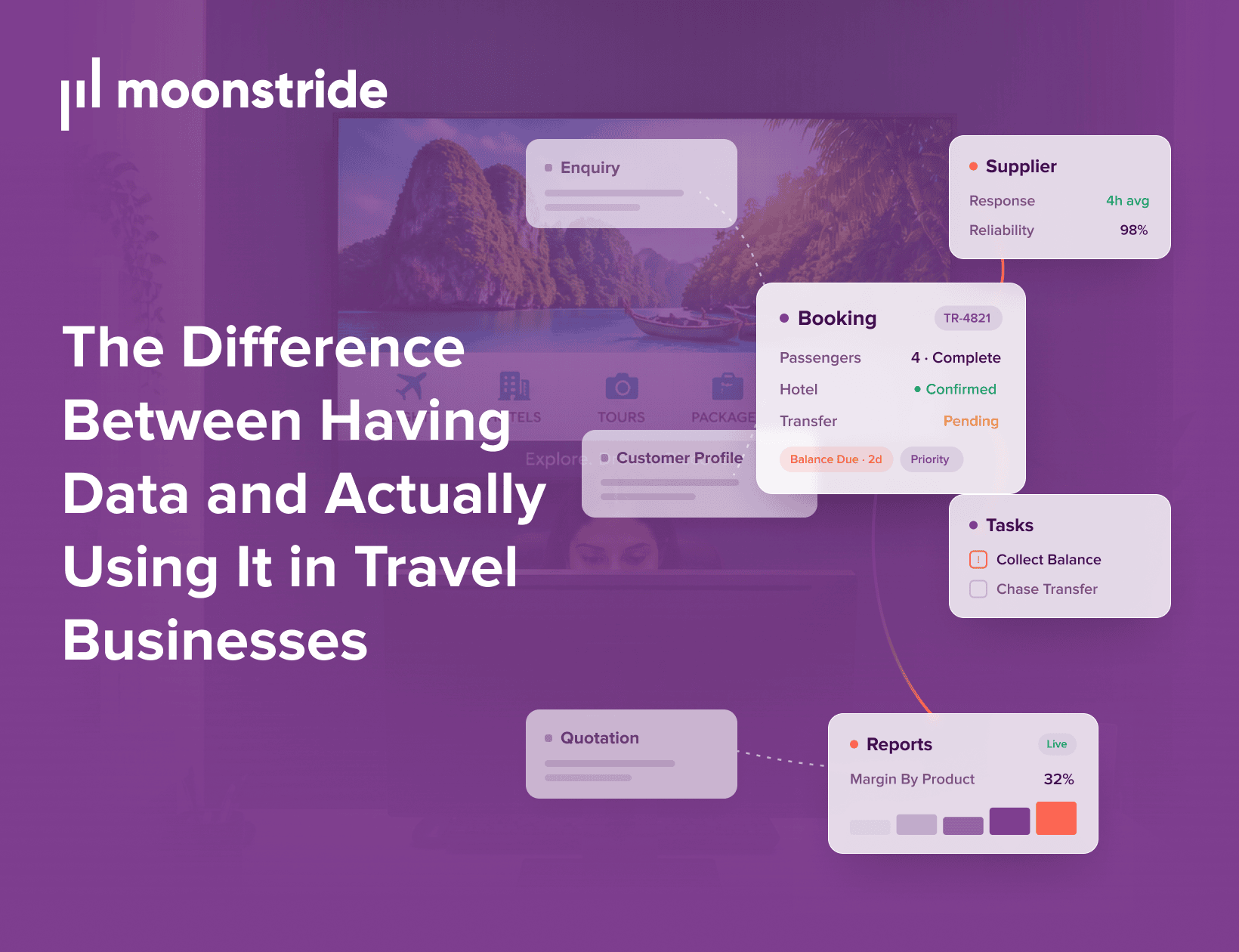
Travel businesses collect information throughout almost every stage of their operations. Customer requirements are captured when an enquiry arrives. Prices and services are recorded while preparing a quotation. Passenger details, supplier confirmations, payments and amendments are added as the booking progresses. Sales figures and financial information are then presented in reports.
This means most travel businesses do not lack data. In fact, many have more information than they realise. The problem is that storing data is not the same as using it.
A travel agency may have thousands of customer records but still send broad, irrelevant follow-ups. A tour operator may record the value of every booking but remain unable to identify which products deliver the strongest margins. A DMC may hold extensive supplier information but still rely on emails and spreadsheets to resolve operational issues.
The difference lies in what happens after the information has been recorded. Useful data influences a decision, identifies an action or changes how a customer, booking, product or supplier is handled.
Having Data Means Storing Information; Using It Means Acting on It
Having data means the information exists somewhere within the organisation. Customer contact details may be stored in a CRM. Enquiries may be logged in a sales pipeline. Quotations may be saved as documents. Bookings may be recorded in a reservation system. Supplier terms may be held in spreadsheets, while payment details sit in accounting software.
All of this information may be available without regularly affecting what employees do next.
Actually using data means applying it to a practical question or decision.
A consultant uses a customer’s previous preferences to prepare a more relevant proposal. A sales manager reviews enquiry sources to decide where to direct marketing investment. An operations manager identifies a booking with missing passenger information before it affects departure. A product manager compares supplier costs with selling prices before approving a new rate.
The distinction is therefore not between having a small amount of data and having a large amount. It is between information that is passively stored and information that actively shapes sales, service, operations and commercial decisions.
When Available Data Creates Little Operational Value
Information does not become useful simply because employees can technically access it. Consider a travel agency that records every customer’s destination interests, budget and previous trips. If consultants do not review those details when handling a new enquiry, the records provide little practical value.
A tour operator may know the total selling price of each booking. However, that figure cannot explain profitability unless it is considered alongside supplier costs, mark-ups, discounts, commissions and later amendments.
A DMC may maintain hundreds of supplier records. Yet if those records are not used to compare response times, rate changes or confirmation reliability, supplier selection may still depend on familiarity rather than evidence.
Group travel organisers may hold passenger names, room requirements and payment records but continue to check separate files manually to identify missing details or unpaid deposits.
The data exists in each situation. What is missing is a clear connection between the information and the action it needs to support.
Recording Enquiries Versus Acting on Sales Opportunities
When a new enquiry arrives, most travel businesses capture basic details such as the customer’s name, contact information, destination, travel dates and passenger numbers. That means the business has enquiry data.
Using that information requires going further. Reservations and sales teams need to interpret the enquiry within its wider context:
- Where did the enquiry come from
- Has the customer travelled with the business before
- How close is the proposed departure date
- What is the likely booking value
- Has a consultant been assigned
- How long has the customer been waiting for a response
- Has a quotation been prepared or followed up
- Why were similar enquiries won or lost
These details support decisions about which opportunities need immediate attention, which marketing channels generate valuable enquiries and where potential bookings are being lost.
For example, recording that 300 enquiries were received during a month provides a volume figure. Reviewing how many converted, where they originated, how quickly they were answered and why others were lost provides information that can guide sales activity.
A structured enquiry management process turns each enquiry from a static record into a trackable opportunity. Enquiry ownership, source, progress and communication activity can then contribute to decisions rather than remaining isolated fields in a database.
Customer Records Versus Useful Customer Knowledge
Customer records often contain names, email addresses, telephone numbers, passport information and previous booking references. These details are necessary, but they do not automatically create a personalised experience.
Using customer data means applying what the business knows when preparing, selling and delivering the next trip. This may include:
- Previous destinations and travel styles
- Accommodation and room preferences
- Dietary or accessibility requirements
- Typical budget range
- Preferred departure airports
- Past feedback or service issues
- Communication preferences
- Previous enquiries that did not become bookings
- Important dates or reasons for travel
A travel consultant who can see this context does not need to begin every conversation from the beginning. The information may shape the hotels included in a proposal, the services recommended or the way the customer is contacted.
The distinction is important. A database may contain ten years of customer history, but that history only becomes valuable when it informs the next interaction.
Bringing profiles, preferences and communication history together through customer profiling gives employees a more useful view of the traveller. The purpose is not simply to retain more records, but to make relevant information available when a new enquiry, quotation or booking is being handled.
Saving Quotations Versus Learning from Their Outcomes
Quotations contain valuable commercial information. They record the destinations, services, proposed prices and travel arrangements presented to potential customers. However, many businesses treat quotations mainly as documents to be sent and stored.
Using quotation data means examining what happens after the proposal is created. Managers may need to understand:
- How long it takes to prepare and send a quotation
- How often quotations require revisions
- Which services or destinations convert most frequently
- Whether response time affects acceptance
- Which proposals are awaiting follow-up
- Why customers reject or abandon quotations
- How often price, availability or itinerary fit influences the outcome
Saving a proposal confirms what was offered. Analysing the quotation journey explains how effectively the business responds to demand.
A quotation management system can retain the customer, service and pricing context behind each proposal. This makes quotations part of the wider sales process rather than standalone files that disappear into inboxes after they are sent.
Recording Booking Data Versus Using It to Control Operations
Once a quotation is accepted, the amount of information associated with the trip increases considerably. A booking record may contain passenger details, accommodation, flights, transfers, activities, supplier confirmations, documents, payments and special requirements. Recording these items means the organisation has booking data. Using that data means turning it into operational control.
Operations teams need clear visibility of:
- Services that have not yet been confirmed
- Supplier deadlines that are approaching
- Missing passport or passenger information
- Outstanding deposits or final balances
- Amendments that affect other trip components
- Documents that still need to be issued
- Rooming or allocation issues
- Tasks without a clear owner
- Departures requiring immediate attention
A booking record therefore needs to show more than what the customer purchased. It needs to indicate what has been completed, what remains outstanding and what could place the trip at risk. This is particularly important for DMCs and group travel organisers, where a single booking may involve several suppliers, passengers, transfers, rooms and payment stages.
Through travel booking management, customer, service, supplier, payment and confirmation information can remain associated with the booking from quotation to completion. Employees can use the record to guide delivery rather than reconstructing the latest position from separate emails and files.
Tracking Sales Versus Understanding Profitability
Sales figures are among the most commonly reviewed forms of travel data. Businesses often track total booking value, number of confirmed bookings and revenue generated during a particular period. These figures show activity, but they do not necessarily explain commercial performance.
A high-value booking is not always a profitable booking. A popular destination may generate significant revenue while producing weaker margins because of supplier price changes, heavy discounting or high commission costs.
Actually using sales and pricing data means comparing:
- Revenue with gross margin
- Selling prices with supplier costs
- Conversion rates by enquiry source
- Profitability by product, destination or departure
- Discounts applied across bookings
- Commission arrangements
- Cancellation and amendment patterns
- New customers with repeat customers
- Consultant, branch or agent performance
This changes the conversation from “How much did we sell?” to “Which sales were commercially worthwhile, and why?”
moonstride pricing manager supports this distinction by bringing rates, mark-ups, margins, commissions, discounts and payment conditions into the pricing process. Commercial information is more useful when it can influence the price before the booking is confirmed, rather than only appearing in a retrospective financial report.
Supplier Records Versus Evidence-Based Supplier Decisions
Supplier records may include contact details, contracts, rates, payment terms, commission arrangements and booking history. Maintaining this information is important, but storing it does not mean it is being used to assess supplier relationships.
Tour operators and DMCs may gain more value by considering:
- How quickly a supplier responds to availability requests
- How reliably services are confirmed
- How frequently rates change after quotation
- The number and type of booking amendments
- Recurring service issues
- Booking volume and commercial value
- Payment and cancellation conditions
- Profitability across the services supplied
This gives product and operations managers a broader basis for choosing suppliers, negotiating contracts or preparing alternatives.
A supplier that offers an attractive rate but regularly delays confirmations may create additional operational costs. Another supplier may receive substantial booking volume without delivering terms that reflect the value of the relationship.
With supplier profile management, contacts, commercial terms and supplier-related information can be maintained in a consistent structure. The value comes from using that information during contracting, quotation, booking and performance review-not from building a larger supplier directory.
Producing Reports Versus Acting at the Right Time
Reporting is often treated as evidence that an organisation is data driven. Monthly and quarterly reports may show sales, booking volumes, cancellations, revenue and customer activity. These summaries are valuable for understanding what has already happened. However, knowing what happened last month does not always tell employees what requires attention today.
Operational use of data includes identifying:
- A high-value enquiry that has not received a follow-up
- A quotation waiting for supplier rates
- A departure with incomplete passenger details
- A booking with an approaching payment deadline
- A service that remains unconfirmed
- A product whose margin is falling
- A supplier issue affecting several active bookings
- A consultant or branch with a growing backlog
Historical reporting and current action are not competing approaches. Travel organisations need both. The difference is that one supports review, while the other supports intervention.
An effective reporting suite enables managers to interpret sales, financial, booking and operational information rather than simply producing totals. A report becomes useful when the reader understands what the figures mean, what sits behind them and whether any action is required.
A Practical Comparison of Recording and Using Travel Data
The difference becomes clearer when the same operational areas are viewed side by side.
| Area | Having data | Actually using it |
|---|---|---|
| Customer records | Storing profiles, contact details and booking history | Applying preferences and previous behaviour to quotations and communication |
| Enquiries | Recording customer requirements | Prioritising opportunities, planning follow-ups and analysing conversion |
| Quotations | Saving proposals and prices | Reviewing response times, revisions, outcomes and reasons for loss |
| Bookings | Recording passengers, services and values | Identifying risks, deadlines, missing information and outstanding actions |
| Pricing | Holding rates and selling prices | Comparing costs, mark-ups, discounts, commissions and margins |
| Finance | Recording invoices and payments | Monitoring balances, liabilities, cash exposure and profitability |
| Suppliers | Storing contacts, contracts and rates | Comparing reliability, commercial terms and service performance |
| Reports | Producing periodic summaries | Guiding current operational and management decisions |
In every case, “having” describes the presence of information. “Using” describes the decision, response or change that follows.
Moving from Data Collection to Practical Action
Moving from data collection to practical use begins with a different question. Instead of asking, “What information can we record?”, managers can ask, “What decision or action does this information need to support?”
Start With a Real Operational Decision
Identify a question that employees regularly need to answer. This could include:
- Which enquiries require priority follow-up
- Which bookings are at operational risk
- Which products are generating the best margins
- Which customers are suitable for repeat booking activity
- Which suppliers require review
The required data becomes clearer once the decision is defined.
Record Information Consistently
Agree on standard definitions for enquiry sources, booking stages, cancellation reasons, customer types and margin calculations. Employees need to understand both what to record and why it matters.
Capture Information as Work Happens
Record data while the enquiry, quotation, booking, payment or supplier interaction is taking place. Reconstructing it weeks later usually results in missing context.
Make Information Relevant to Each Role
A consultant, operations manager, finance employee and director do not need identical views. Each role needs access to the information relevant to its decisions.
Turn Information Into a Next Action
Useful data leads to a clear response – make a follow-up call, confirm a service, collect a balance, review a margin, contact a supplier or reassign a task.
Features such as task management are valuable when operational information can be translated into assigned work with ownership and deadlines.
Review Whether Anything Changed
A report is not successful simply because it was produced. Managers need to assess whether it influenced pricing, follow-up activity, resource allocation, supplier selection or another decision.
If nobody acts on a metric, the organisation needs to consider whether it is useful, presented at the right time and clearly understood by employees.
How moonstride Turns Recorded Data into Daily Action
The value of moonstride is not limited to keeping travel information in one place. Its practical role is to carry information through the workflows in which it needs to be understood and applied.
Enquiry Data Becomes Sales Action
Enquiry details, sources, stages, ownership and communication activity provide sales teams with the context needed to prioritise and follow up opportunities. Instead of treating every enquiry as an isolated request, managers can examine its progress and understand where potential bookings are delayed or lost.
Customer Records Become Relevant Service
Customer preferences, communication history and previous bookings provide consultants with useful context when preparing a new proposal. The record is no longer simply an archive. It informs how the customer is approached and what is recommended.
Quotations Become a Source Of Commercial Learning
Quotation details can remain associated with the enquiry, customer, services and pricing. This supports more informed follow-up and a better understanding of the proposals that become bookings.
Booking Records Guide Delivery
Passenger information, services, confirmations, payments, documents and activities can be viewed in relation to the booking. Operations teams can identify what has been completed and what still requires attention without rebuilding the latest position manually.
Pricing Data Supports Margin Control
Costs, mark-ups, commissions, discounts and selling prices can be considered as part of the pricing workflow. This gives commercial teams a clearer view before the price reaches the customer.
Supplier Information Supports Operational Choices
Supplier contacts and commercial arrangements can be used during quotation, booking and fulfilment rather than remaining in separate reference files.
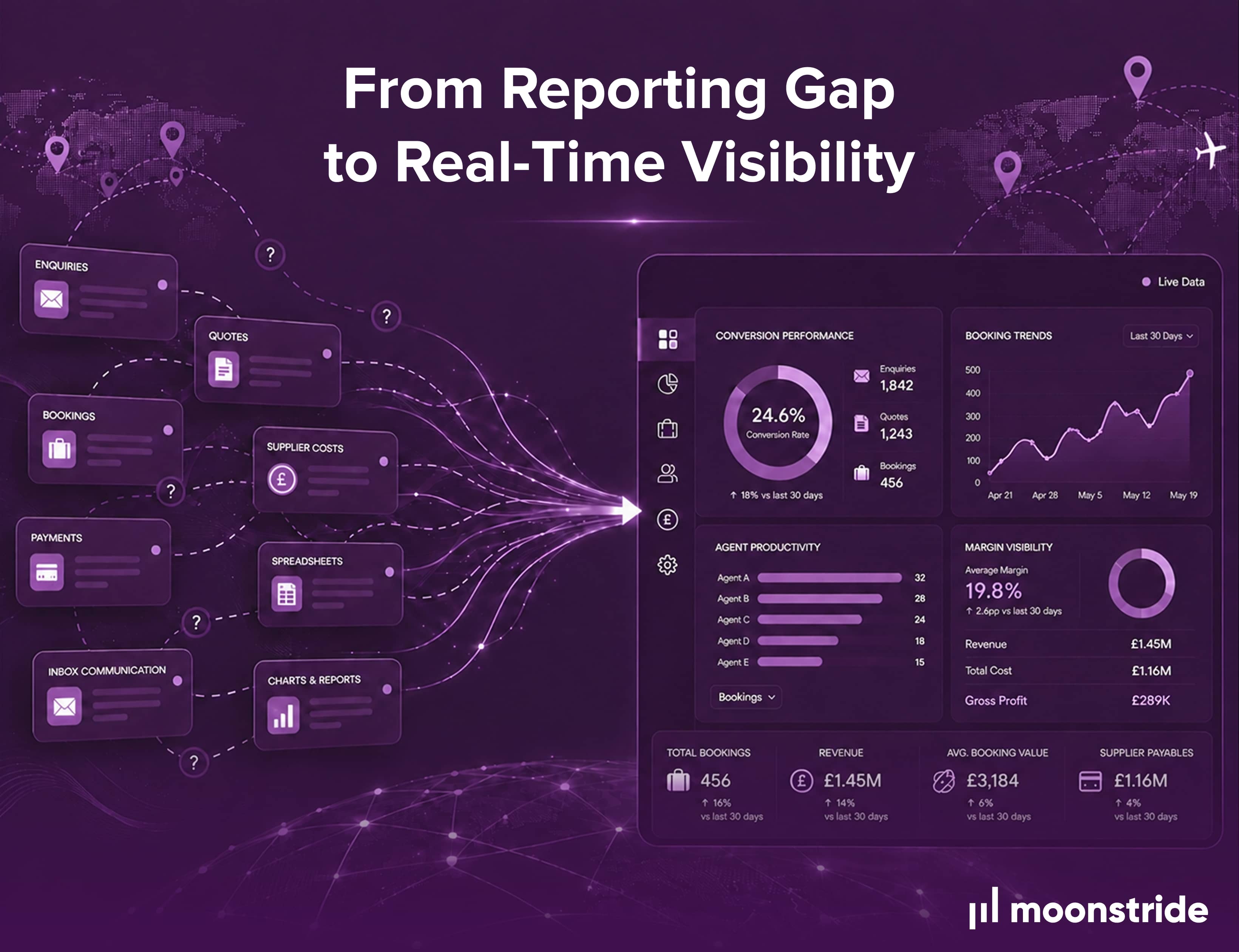
Reports Support Management Decisions
Sales, operational, booking and financial information can be reviewed in relation to the activity behind each figure. The objective is not to display more charts. It is to give managers enough context to understand what happened, what is happening and where attention is required.
Let’s Put the Data you Already Have to Work
Having data means the information exists. Actually using data means that the information changes what happens next.
It influences which enquiry receives attention, how a quotation is prepared, when a customer is contacted, which booking is reviewed, how a product is priced and whether a supplier relationship remains commercially worthwhile.
Travel organisations do not gain value according to the number of records, reports or dashboards they possess. Value is created when reliable information reaches the right person, at the right stage of the workflow, with enough context to support a decision.
That is the difference between being a business that collects data and one that genuinely operates with it.
Share on




Write a Comment
Leave a reply
Your email address will not be published. Required fields are marked *